
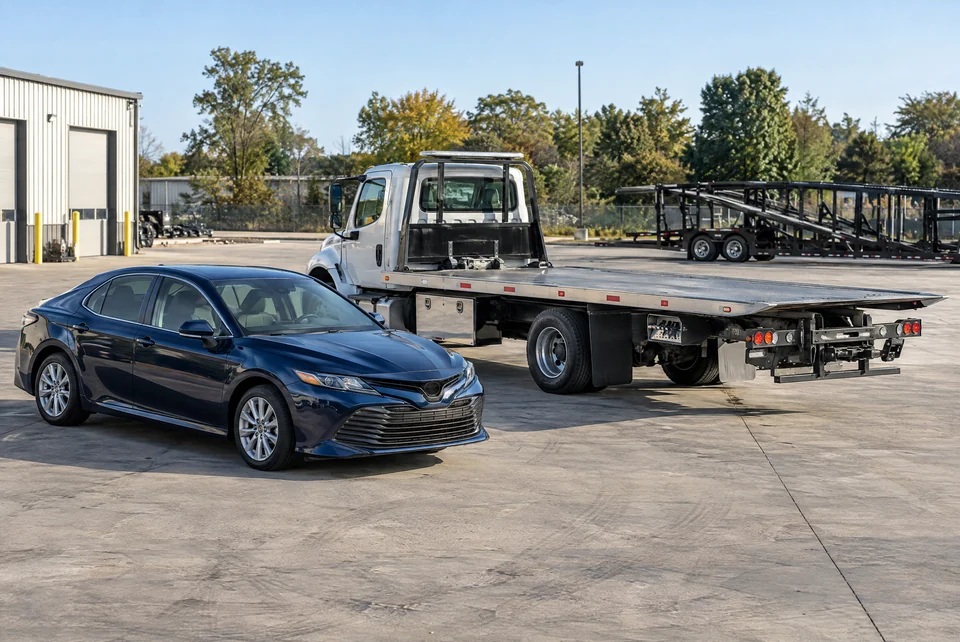
A breakdown across town and a planned shipment across several states present different problems, even though both require moving a car. Towing often addresses an immediate local movement or recovery need; scheduled auto transport organizes a vehicle shipment around a carrier and route. Some jobs need both. Start by describing where the car is and what it can do, then select suitable equipment and coordination.
What to know first
- Separate an immediate recovery need from a planned transport booking.
- Describe rolling, steering and braking capability, not just whether the engine starts.
- Check the vehicle manufacturer’s towing instructions before agreeing to a method.
Resolve the immediate location first.
A car stranded in a traffic lane, on an unsafe shoulder or in a location requiring prompt removal needs an appropriate roadside or recovery response. A scheduled interstate shipment is not a substitute for emergency assistance. Provide the location and circumstances to the appropriate local service.
Once the vehicle is secure, decide where it should ultimately go. Moving it to a repair shop or accessible holding location may make a later carrier pickup possible. Ask about release hours, parking permission and storage terms before choosing an intermediate stop.
Describe the mechanical situation in plain terms.
Tell the provider whether the car starts, can be shifted into the required position, rolls freely, steers and has functioning brakes. Include flat tires, locked wheels, suspension damage, fluid leaks and missing keys. “Non-running” alone leaves important loading questions unanswered.
Send clear photos of the vehicle and its surroundings if requested. A car parked nose-first in a tight garage presents a different job from the same car on an open paved lot. Do not attempt to move a damaged or immobilized vehicle solely to fit a generic booking form.
Identify how the wheels will travel.
Towing can involve several equipment types; the word does not identify whether all wheels remain off the road. Manufacturer requirements vary with model, drivetrain and situation. Ford, for example, directs owners to vehicle-specific towing guidance rather than treating every vehicle as suitable for flat towing.
Provide the exact year, model and drivetrain and consult the applicable owner’s manual. Ask the operator to confirm a compatible method, including loading and securing. A transport trailer also requires a suitable loading plan; having space on a deck does not solve locked-wheel or low-clearance problems.
Compare the complete movement, not mileage alone.
For a planned local move, compare availability, loading method, required access and the written total. For a longer shipment, ask whether a scheduled carrier can collect directly or whether a separate local movement is needed. Neither distance nor vehicle value creates a universal dividing line.
If two providers are involved, establish who books each stage and who pays any storage or additional handling charge. Confirm how the first provider releases the car to the second. An uncoordinated transfer can leave the vehicle ready in one place while the receiving carrier expects another.
Keep a condition record between providers.
Photograph the vehicle before each handoff where it is safe and practical. Record existing damage, odometer display, keys supplied and any parts traveling separately under an agreed arrangement. Keep the first receipt and the later pickup record together so the sequence is understandable.
Ask each business about its applicable coverage and reporting process without assuming the towing and transport portions share the same terms. For an interstate transport provider, FMCSA’s authority lookup is one part of checking the business; it does not establish the details of every possible cargo claim.
Ask for the right service by describing the job.
A useful request reads: “The car is at a repair shop, does not start, rolls and steers, has keys, and must reach this destination.” Add access photos and the required dates. Driveline can manually review a planned non-running shipment and identify details needed before equipment suitability is confirmed.
- Does the vehicle need recovery before a carrier can approach it?
- Which wheels, if any, would touch the road during the proposed move?
- Can the receiving location accept and reposition a non-running car?
- Who coordinates release if towing and transport are separate bookings?
Plan your next step
Review non-running vehicle transport ↗Describe your vehicle and location ↗Sources & further reading
Explore the service
Non-running vehicle transport ↗Published by Driveline Logistics. Guides explain planning considerations; shipment-specific equipment, availability and written terms are confirmed before booking.