
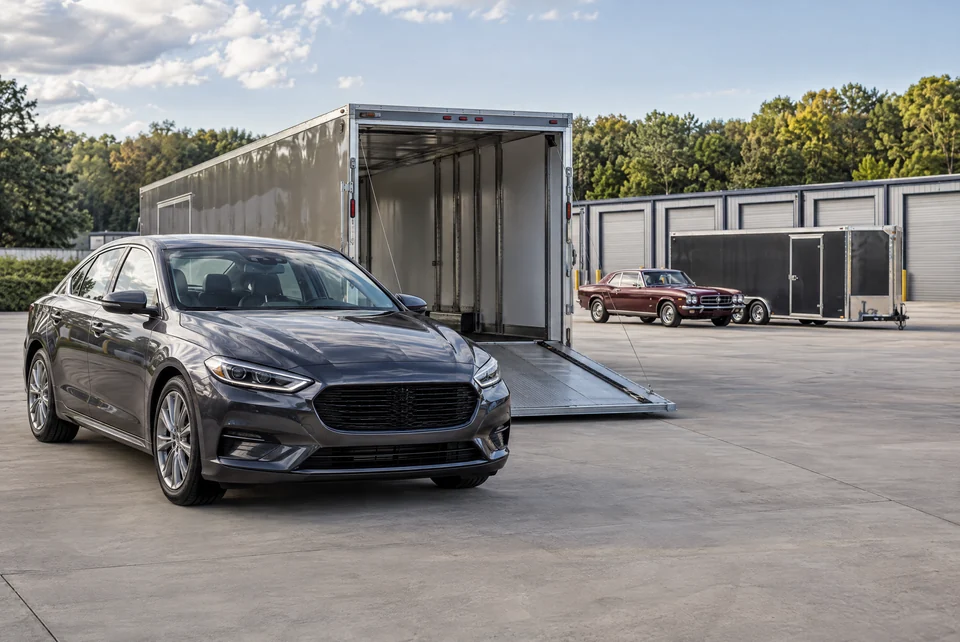
The right transport type starts with the car and the priorities of its owner. Open and enclosed transport solve the same basic problem—moving a vehicle without driving it to the destination—but the trailer environment and equipment options differ. Here is a practical way to compare them without treating either choice as a universal answer.
What to know first
- Open transport suits many everyday vehicles and inventory moves.
- Enclosed transport adds shelter but does not automatically mean dedicated service or unlimited coverage.
- Ground clearance, modifications and access can matter as much as the car’s price.
Start with how the vehicle is used.
A daily-driven sedan, a family SUV and a restored collectible bring different priorities. For an everyday vehicle, open transport may offer a sensible balance of availability and cost. The car travels on an open carrier and remains exposed to the weather and road environment.
For a freshly restored classic, a special finish or a car you want to keep out of that environment, enclosed transport may be worth discussing. The decision is about the protection you want during the journey, not a rule that every expensive car must use the same trailer.
Compare Driveline’s preliminary rates.
For a running, unmodified vehicle, the open-transport estimate uses $2 per mile through 1,000 estimated miles or $1.80 above that distance. Enclosed rates use vehicle value, starting at $2.50 per mile below $200,000 and rising through published value bands.
The selected rate applies to the whole trip. Non-running vehicles use the condition rate; modified vehicles require a manual quote. Estimated miles are based on ZIP-code centers multiplied by 1.2, not an actual road route. Compare the equipment and final written terms as well as the number.
Look at loading, not just the walls.
The trailer enclosure is only part of the plan. A long front splitter, low ride height or wide body kit can make the loading approach important. Ask how the vehicle will enter and leave the trailer, what equipment is available and whether your actual dimensions are compatible.
An enclosed trailer does not automatically have a liftgate. Featherlite’s car-trailer brochure, for example, describes its enclosed Model 4941 with a rear ramp. An open carrier is not automatically unsuitable for every performance car. Confirm the specific equipment and loading method instead of relying on a category label.
Compare equivalent quotes.
A useful comparison keeps the route, vehicle, pickup window and delivery access the same. Check whether each quote covers shared or dedicated capacity, the proposed loading method and the same timing expectations. If one option includes a requirement the other omits, the headline prices are not directly comparable.
Do not assume a fixed percentage difference between open and enclosed. Availability, the lane, season, vehicle size and urgency all influence the actual proposal. A current written quote is more useful than a generic internet average.
Ask the questions that change the decision.
Before selecting a service, explain what you care about most: minimizing exposure, accommodating a modified car, meeting a receiving window or keeping the transport budget practical. Then ask the transport provider to explain the tradeoffs for this particular move.
- Is the proposed capacity shared or dedicated?
- How will the vehicle be loaded and secured?
- What are the pickup window and transit assumptions?
- What coverage information will be available for the assigned carrier?
- Can the truck access both requested locations?
Make the choice around your move.
For a typical daily driver with flexible dates, open transport is a reasonable option to compare first. For a collectible, specialty finish or low-clearance vehicle, start a more detailed enclosed-transport conversation. In either case, keep condition photos, confirm the written terms and make sure the pickup contact understands the plan.
Driveline can review either request. Include your vehicle, route and priorities so the recommendation is tied to the move you are actually planning.
Plan your next step
See Driveline’s published rates and mileage method ↗Calculate your preliminary car shipping price ↗Shared vs. dedicated enclosed transport: what to discuss ↗Shipping a low-clearance car: plan around the splitter ↗How to compare car shipping quotes beyond the headline price ↗Sources & further reading
Explore the service
Enclosed auto transport ↗Published by Driveline Logistics. Guides explain planning considerations; shipment-specific equipment, availability and written terms are confirmed before booking.