
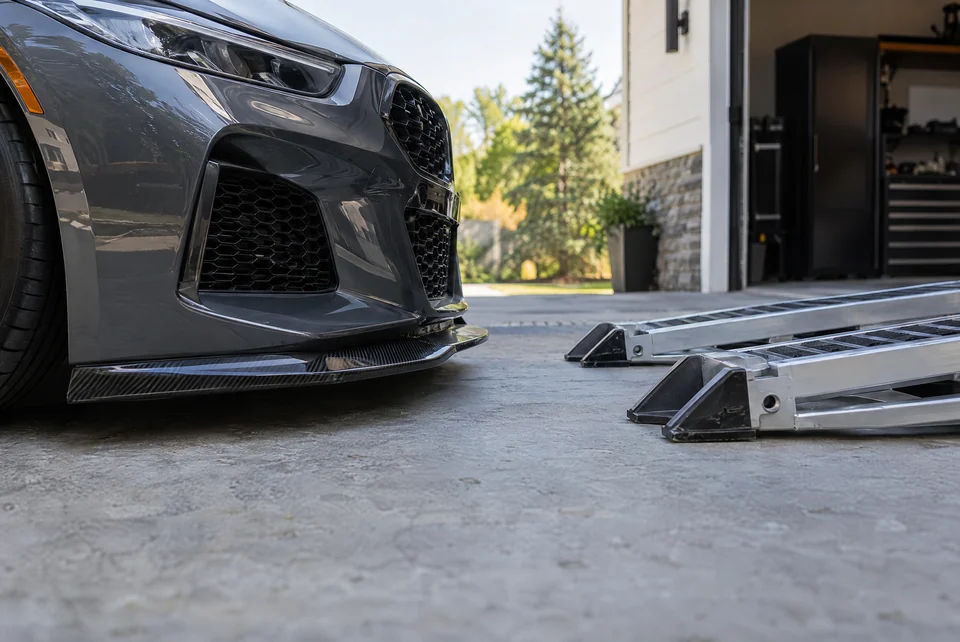
A low car needs a loading plan that accounts for more than a ground-clearance number. Front overhang, wheelbase, suspension height and the shape of the loading transition all matter. Start that conversation before booking, especially when the car has been modified from its factory specification.
What to know first
- A model name does not fully describe a modified car’s loading needs.
- Liftgates and ramp systems are options to confirm, not automatic guarantees.
- Provide measurements and handling instructions before dispatch.
Describe the lowest and longest points.
Ground clearance is a useful starting point, but a long splitter can reach the ramp transition before the front wheels do. Side skirts, underbody components and the rear overhang may also influence the loading path.
Give the coordinator the actual car’s details. If it has coilovers, a body kit, different wheels or other changes, say so. A stock photograph or a factory specification may no longer represent the vehicle being collected.
Request a quote for a lowered or modified car.
A lowered or otherwise modified vehicle should use Driveline’s modified-vehicle request path. Provide the route, vehicle, modifications, ground clearance and contact details. The team emails a tailored quote within 30 minutes of receiving the completed request.
There is no automatic price for a modified vehicle. The confirmation email records receipt; it does not replace the team’s equipment review or the tailored quote. Confirm the loading approach and final written terms before booking.
Explain adjustable suspension correctly.
If the car has a factory lift function or adjustable ride height, explain how it operates and any manufacturer restrictions. Confirm whether the pickup contact knows the procedure and whether power is available to use it.
Do not assume that a temporary raised position can be used throughout the trip or that a transporter can change suspension settings without instruction. Agree on the handling process with the actual equipment and vehicle guidance in mind.
Ask about the complete loading path.
Liftgate loading and systems such as Race Ramps can provide options for certain vehicles, but suitability depends on the equipment, capacity and configuration. Race Ramps’ own measuring guide checks the vehicle’s approach angle together with the trailer door’s length, height and thickness. Ask how the car will move from the ground to the final position, including each transition, and have the operator confirm compatibility with the actual setup.
Confirm what happens at delivery as well as pickup. A loading solution at the origin is only half a plan if the destination requires a different unloading arrangement.
Prepare useful information.
A short, clear description is more useful than simply writing “very low.” Supply what you can measure and identify any uncertainty. Photos can support the discussion, particularly side views that show overhang and clearance.
- Year, make, model and relevant modifications
- Approximate lowest ground clearance
- Front splitter or rear overhang concerns
- Wheelbase or dimensions if requested
- Suspension-lift instructions and key access
- Known loading issues from previous moves
Agree on compatibility before arrival.
The loading method should be matched to the actual car and trailer. If the setup is not suitable on arrival, it is better to pause and resolve the mismatch than to rely on an improvised approach that was never discussed.
Driveline’s custom and enclosed requests include space for special requirements. Use it to flag low clearance early. No website image can certify a loading setup; suitability is confirmed for the real vehicle, location and equipment.
Plan your next step
See Driveline’s published rates and mileage method ↗Calculate your preliminary car shipping price ↗How to measure a vehicle for transport: height, width and clearance ↗Car transport with air suspension: record the approved loading setup ↗Porsche 911 transport: model-specific clearance and loading questions ↗Sources & further reading
Explore the service
Custom & specialty vehicle transport ↗Published by Driveline Logistics. Guides explain planning considerations; shipment-specific equipment, availability and written terms are confirmed before booking.